Are you looking for does pellet stoves use a lot of electricity? Pellet stoves are a popular heating option in many homes. They burn wood pellets to produce heat, but many people wonder about pellet stove electric usage, and whether they cost too much in electricity. In this guide, we will answer questions like “how much electricity does a pellet stove use”, “do pellet stoves require electricity”, “are pellet stoves efficient”, and more. We’ll also look at pellet stove efficiency ratings for 2025, and how to minimize power costs.
If you are looking for details about streamers, juicers and electric stove, small kitchen appliances guide has it all. A lot of customers are still unsure of the question: does pellet stoves use a lot of electricity? In the next section, we will shed some light on the power requirements and heating benefits of installing a pellet heater.
What is a Pellet Stove & Why Does It Use Electricity
A pellet stove is a heating appliance that burns compressed wood or biomass pellets. It uses an automatic feeding system (auger) to add pellets from a hopper into a burn pot, where they ignite, and fans or blowers to circulate air and clean up exhaust.
Because of these parts, pellet stoves require electricity. Specifically:
- The igniter (electric start) to light the pellets.
- The auger motor that feeds pellets into the fire.
- Blower fans and possibly an exhaust fan, to move warm air and remove smoke.
- A control panel / thermostat to regulate temperature.
Without electricity, many pellet stoves cannot operate, especially modern models. So yes, do pellet stoves need electricity to function properly. If the power goes out, most pellet stoves stop working (except a few non-electric models).
How Much Electricity Does a Pellet Stove Use
This is one of the most asked questions. How much power does a pellet stove really draw?
- During ignition (startup), the stove uses more electricity. Typical startup/ignition wattage can be 300-500 watts or even higher depending on model.
- Once running, the power needed drops. Some pellet stoves run with 100-200 watts during continuous heating.
- Average daily use depends on how long the stove is on, what setting (low, medium, high), and how well insulated your home is.
Example calculation: If your pellet stove runs 8 hours on an average running power of 150 watts, then electricity used = 150 W × 8 h = 1,200 watt-hours, i.e. 1.2 kilowatt-hours (kWh). At, say, $0.15 per kWh, this costs about $0.18 for 8 hours—but this varies widely by your local electricity rates. (Note: pellet fuel cost is separate.)
So, how much electricity a pellet stove uses depends a lot on its model, usage hours, and the efficiency of its components.
Pellet Stove Efficiency: What Does It Mean & Efficiency Ratings
Pellet stove efficiency refers to how well the stove converts pellets into usable heat and how much electricity it uses in that process. Efficiency has multiple parts:
- Combustion efficiency : how completely the pellets burn.
- Heat transfer efficiency : how well the heat gets from the fire into your room (via metal surfaces, blower fans).
- Electrical efficiency : how much electricity for fans, controls etc., relative to heat produced.
Pellet stove efficiency ratings are usually expressed as percentages. For example:
Many good pellet stoves in 2025 have efficiency ratings between 70% and 85%. That means 70-85% of the energy in the pellets becomes heat in your room.
Some very high-end or well-designed models may reach a bit higher under ideal conditions.
Are pellet stoves energy efficient? Yes. A properly sized, well-maintained pellet stove can be much more efficient than open fireplaces or older wood stoves. They produce less smoke, burn pellets more cleanly, and often offer more controlled heating.
Factors That Affect Electricity Use and Efficiency
Several things influence how efficient your pellet stove is and how many watts it draws or how much electricity it uses:
1: Model size and features:
Larger stoves with bigger hopper, more powerful fans, or multi-speed blowers use more electricity.
2: Ignition cycles:
Each time you start the stove, the igniter draws more power. Frequent on/off cycles increase electricity usage.
3: Fan/blower speed:
Higher speeds use more electric energy.
4: Home insulation & heat loss:
If your room or home loses heat quickly, your stove works harder and longer, using more electricity and pellets.
5: Pellet quality:
High quality, low-moisture pellets burn more efficiently and reduce waste.
6: Operating mode:
Running at “low” settings uses less electricity; running at maximum power uses more.
7: Heat Distribution:
Due to built-in fans distributing heated air throughout the area, continuous electricity is required. The precise amount of electricity needed is determined by the fan’s dimensions, speed, and the preset heat levels.
Control Systems:
As with all electronics, digital panels and thermostats to maintain the desired temperature and keep the stove operating to optimal levels, also draw a small, continuous amount of power.
Pellet Stoves vs Other Heating Systems: Are They Strong Competition?
Below is how pellet stoves compare with other heating systems in terms of efficiency, cost, and electricity use:
| Heating System | Fuel Type / Power Source | Efficiency Range / Typical Uses | Electricity Use |
|---|---|---|---|
| Pellet Stove | Biomass pellets + electricity | 70-85% efficient; steady heat; lower emissions | Uses electricity for ignition, auger, fans; often ~100-400 W when running |
| Wood‐burning stove | Wood logs, no electricity (for basic models) | Lower efficiency (open fire) ~10-30%; more manual work | Little to none (unless fans or dampers with power) |
| Gas Heater / Gas Furnace | Natural gas or propane | Efficiency ~70-98% for modern units with sealed combustion | Gas heaters often only need electricity for ignition or fan, less than pellet stove in many cases |
| Electric Heater (resistance) | 100% electricity | Efficient for converting electricity to heat, but cost per kWh is high | Uses only electricity; possibly higher cost overall |
So yes, how efficient are pellet stoves depends on comparing both fuel cost and electricity usage. Many people find a pellet stove is more cost-efficient than running purely electric heaters, especially in cold climates with high electricity rates. Also, the environmental impact is often lower because pellets come from renewable biomass sources.
Pellet Stove vs. Electric & Gas Heating
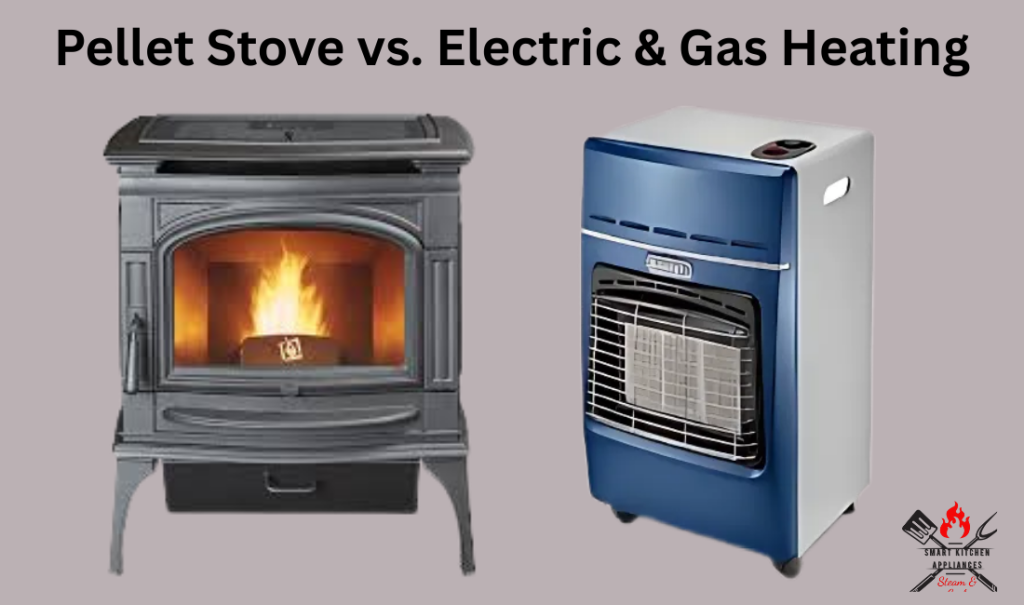
| Aspect | Pellet Stove | Electric/Gas Heating |
| Operating Cost | $120–$200/month (mostly pellet cost + $10–$20 electricity) | Depends on utility rates; can be higher when fuel prices spike |
| ️ Heat Coverage | Best for single rooms or small/medium homes | Whole-home heating with even distribution |
| Electricity Use | Low (mainly for fans & auger; $10–$20/month) | Higher for electric resistance; minimal for gas furnaces |
| Eco-Friendliness | Renewable biomass fuel; EPA-certified stoves produce less smoke & pollution | Gas = fossil fuel; Electric = depends on power source mix |
| ️ Maintenance | Requires weekly cleaning + pellet refilling | Minimal for gas/electric systems |
| Lifespan | 10–15 years (up to 20 with maintenance) | 15–20 years (varies by system type) |
| Upfront Cost | Several thousand dollars + professional installation | Higher for furnaces but often included in new builds |
Bottom Line:
- Pellet stoves are eco-friendly and cost-effective in the right conditions but need hands-on maintenance.
- Gas and electric systems are lower-maintenance and better for whole-home heating, but may be more expensive depending on utility rates.
Best Practices: Reduce Pellet Stove Electricity Use & Improve Efficiency
To keep electricity usage low and make your pellet stove work efficiently:
- Choose high-efficiency stove models (look for ratings ≥75-80%)
- Use quality pellets with low moisture content
- Preheat wisely and avoid too frequent on/off cycles
- Maintain clean components: clean blower, exhaust, ash collection often
- Use correct size: match stove size to room square footage
- Ensure good insulation in your home to reduce heat loss
- Use lower fan/blower speeds when possible
Does Pellet Stoves Use a Lot of Electricity? (FAQs)
Will a pellet stove increase your electric bill?
Your electric bill will only slightly increase. For the most part, a pellet stove’s fans, auger, and control systems use a small amount of power. They will only add $9 to $15 to your bill. Actually, a lot of homeowners notice that their overall energy costs decline since a pellet stove decreases the use of gas, oil, or electric furnaces.
What is the Monthly Cost of Running a Pellet Stove?
A pellet stove will typically set you back anywhere between $120 to $200 a month. Most of that is going to electric, and pellet prices of $4 to $9 for a 40 lb bag, which averages $250 to $400 a ton. A normal household will go through 2 to 3 tons in a heating season. Add in electric costs, and your expenses will be $10 to $20 a month. These prices are influenced by the climate, the home, and its insulation.
Which Is Cheaper: Pellet Stove Or Natural Gas?
It depends on the scenario. Natural gas is more consistent and cheaper; however, propane and fuel oil tend to make pellet stoves more affordable. Both options have their cost-effective parts. However, pellet stoves are more enticing for homeowners looking to lessen fuel dependence during market price shifts.
What Is The Reason People Are Getting Rid Of Pellet Stoves?
There are a couple of main reasons that people are getting rid of pellet stoves. The first of which is emissions, while others are concerned about the pellet quality. Low-quality pellets tend to be much more carbon-intensive, spilling out carbon monoxide and particulate matter. The second reason is a more convenient heating system that does not require excessive maintenance, cleaning, and pellet loading.
Is it cheaper to run a pellet stove or an electric heater?
Usually, pellet stoves are cheaper to run than electric, oil, or propane appliances. The average household that uses pellet stoves as a primary heating source burns between two to three tons of pellets a year. That’s way cheaper than relying on electric heaters.
Are pellet stoves energy efficient compared to electric heaters?
Yes, Pellet stoves often deliver heat more efficiently because they use biomass fuel plus electricity, and are designed for efficient combustion. Electric resistance heaters use only electricity and may cost more overall.
Can pellet stove run without electricity?
Some basic or gravity-fed pellet stoves can function with minimal electricity or battery backup, but most modern stoves will not run properly without a power source. Fans and auger need power.
Final Thought: Does Pellet Stoves Use a Lot of Electricity?
So, does pellet stoves use a lot of electricity? The short answer: no, not a lot, especially compared to many other electric-only heating options. A pellet stove does need electricity—for ignition, fans, and pellet feeding—but its electricity usage is moderate (often 100-400 watts when running), and the ignition surge is short.
More importantly, pellet stoves tend to be energy efficient, especially when they have good efficiency ratings, are well maintained, and used properly. If you’re comparing options, think about both fuel cost (pellets) and electricity cost, and match your stove to your home’s insulation and heating needs.
If you pick a good model, use quality pellets, maintain it well, and keep your home well insulated, a pellet stove can be an economical, eco-friendly option for heating in 2025.
REFERENCES:
- StoveFireplaces.com — “How Many Watts Does a Pellet Stove Use? Cost Savings & Efficiency”
- PICKHVAC.com — “Pellet Stove Wattage, Electricity and Amp Usage”
- House and Home Online — “How Many Watts Does a Pellet Stove Use: Understanding Energy Consumption and Efficiency”
- LearnMetrics.com — “5 Best Pellet Stoves in 2025 … Energy Efficiency”
- US EPA — Pellet Stoves / Burn Wise info on pellet stove efficiency and how they work